
The Benefits of Talking to a Tele Helath Therapist for Mental Health
Insights from Tele Health Therapist Linda Meaker (Psychologist)
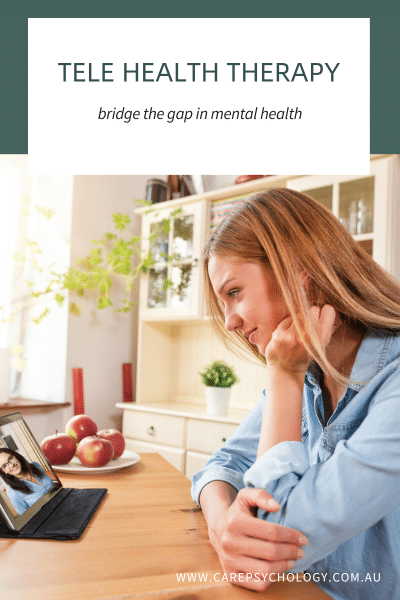
Online therapy, also called eTherapy or telehealth counselling, gives you flexible access to a qualified psychologist by video or phone. Talking to a tele health therapist can suit people with busy schedules, people who live a long way from a clinic, or anyone who simply prefers to talk from home.
How does online tele health therapy work?
Online therapy connects you with a qualified psychologist or counsellor by video, phone or secure messaging. It ranges from structured self-help programs to live sessions with a clinician. Healthdirect lists depression, postnatal depression, anxiety, panic disorder, PTSD and OCD among the concerns it can help with (Healthdirect Australia, 2025).
A session follows much the same path as face-to-face counselling. Your tele health therapist listens, assesses what is going on and tailors therapy to your goals. Check that they are registered with AHPRA and that the platform they use protects your privacy.
Tele health therapy is not new
Telehealth for mental health goes back to the late 1950s, when the Nebraska Psychiatric Institute used closed-circuit television to connect with patients (Nesbitt, 2012).
In Australia, Medicare began funding video sessions with psychologists for people in rural and remote areas in November 2017 (Australian Government Department of Health, 2017). During the COVID-19 pandemic in 2020, Medicare telehealth was opened up to everyone, and online counselling became a mainstream choice. Today I see tele health therapy as an important partner to in-person care, not a replacement for it.
Bridging the gaps with a tele health therapist
Connecting with a tele health therapist makes support easier to reach for many people who might otherwise go without, including:
- people in rural and remote areas, where travel to a clinic can take hours
- those with mobility challenges, chronic illness or caring responsibilities
- time-poor people
- young people who are comfortable communicating through a screen
- people who feel self-conscious about walking into a psychologist’s office.
Talking therapies such as cognitive behavioural therapy (CBT) and acceptance and commitment therapy (ACT) are built on structured conversation and exercises, so they translate well to video. For example, a young person with social anxiety may find a video session from home less daunting than a waiting room, which makes it easier to take that first step.
How effective is talking to a telehealth therapist?
The research is encouraging. One large US study compared 1,192 adults in intensive treatment before the pandemic with 1,192 adults treated by telehealth during it. Both groups had similar improvement in depression symptoms and quality of life (Bulkes et al., 2022).
The tele health therapist’s skill still matters. A 2023 study of 323 therapists found they felt less skilled online than in person. Those who were better at expressing emotion through their face and voice felt that drop the least (Lin & Anderson, 2023). In other words, a psychologist who is warm and expressive on camera can still build a strong connection.
Telehealth is not right for every situation. Some people, including those with more severe or complex concerns, may be better supported in person. I am always happy to talk through which option suits you best.
Privacy and comfort of tele health therapy
Many clients tell me they feel more at ease opening up from their own space. That said, tele health therapy works best when you have a private, quiet spot where you won’t be overheard or interrupted. Service providers in one US study noted both sides of this: clients often felt more comfortable at home, but finding privacy and avoiding distractions could be a challenge (Cassity-Caywood et al., 2023).
How telehealth promotes continuity of care
When lockdowns made in-person sessions impossible, telehealth meant therapy could continue. Regular contact matters, especially for ongoing concerns such as depression or PTSD. Because talking to a tele health therapist removes travel time, many people find it easier to keep their appointments, even fitting a session into a lunch break.
Keeping your tele health therapy sessions secure
In Australia, tele health therapists and psychologists must protect your personal information under the Privacy Act 1988 and meet the same professional and ethical standards online as they do in person. Your psychologist should use a secure platform and explain how your information is stored and how consent works.
Tips for getting the most from tele health therapy
1. Treat online sessions with the same commitment as in-person ones.
2. Choose a private, quiet space with a reliable internet connection.
3. Check that your psychologist uses a secure platform.
4. Use the flexibility to book times that genuinely suit you.
5. Notice whether you feel heard, and whether sessions are tailored to you.
6. Ask your GP about a Mental Health Treatment Plan, which may give you access to Medicare rebates.
How to get started with a tele health therapist
Most of my clients now see me through telehealth, and I love how it makes support easier to reach. If you would like to talk with an experienced tele health therapist from the comfort of your own space, please contact me today on 0423106076.
Online therapy is not a crisis service. If you are in crisis or feel unsafe, call Lifeline on 13 11 14, or 000 in an emergency.
References Used for this Telehealth Counselling Article:
Australian Government Department of Health. (2017). Boost for mental health services in the bush begins today [Media release]. https://www.health.gov.au/ministers/the-hon-greg-hunt-mp/media/boost-for-mental-health-services-in-the-bush-begins-today
Bulkes, N. Z., Davis, K., Kay, B., & Riemann, B. C. (2022). Comparing efficacy of telehealth to in-person mental health care in intensive-treatment-seeking adults. Journal of Psychiatric Research, 145, 347-352. https://doi.org/10.1016/j.jpsychires.2021.11.003
Cassity-Caywood, W., Griffiths, A., Woodward, M., & Hatfield, A. (2023). The benefits and challenges of shifting to telehealth during COVID-19: Qualitative feedback from Kentucky’s sexual violence resource centers and children’s advocacy centers. Journal of Technology in Behavioral Science, 8(1), 87-99. https://doi.org/10.1007/s41347-022-00296-w
Healthdirect Australia. (2025, November). Online therapy (eTherapy). https://www.healthdirect.gov.au/etherapy
Lin, T., & Anderson, T. (2023). Reduced therapeutic skill in teletherapy versus in-person therapy: The role of non-verbal communication. Counselling and Psychotherapy Research. https://doi.org/10.1002/capr.12666
Nesbitt, T. S. (2012). The evolution of telehealth: Where have we been and where are we going? In Institute of Medicine, The role of telehealth in an evolving health care environment: Workshop summary. National Academies Press. https://www.ncbi.nlm.nih.gov/books/NBK207141/